Apr 22, 2025
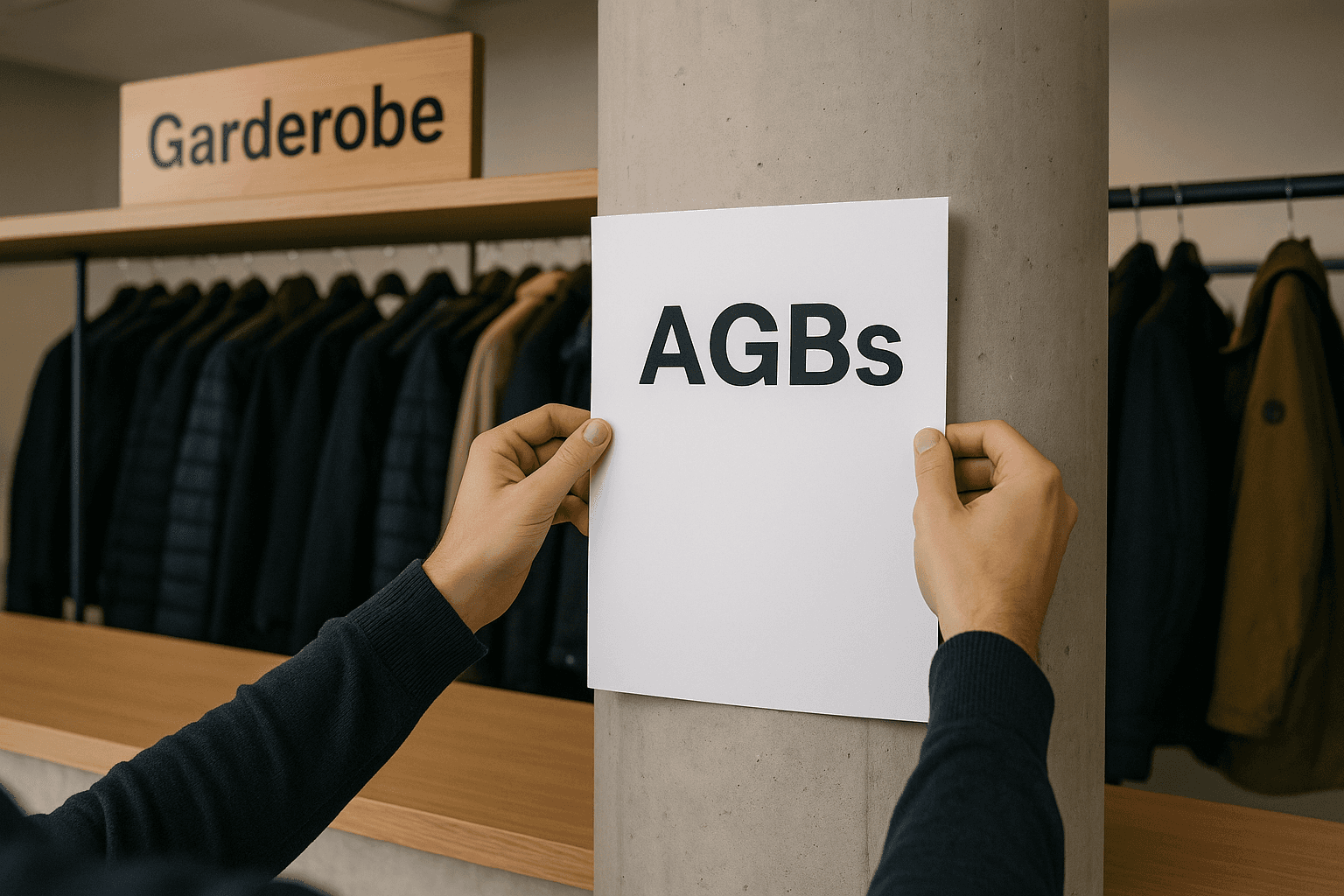
Terms and Conditions at the Cloakroom – Why They Are Important and How to Properly Structure Them


Note: This article does not constitute legal advice. It is intended solely for general information. For a binding legal assessment, please consult a qualified attorney or refer to official legal sources.
Introduction
Coat checks in theaters, clubs, trade fairs, or event halls are an important service for guests. But what happens if a jacket is lost or damaged? Who is liable if a coat check ticket is lost?
Such questions often lead to disputes when there are no clear regulations in place. Terms and Conditions (T&Cs) at the coat check help to avoid these issues by clearly defining duties and limits of liability.
In this article, we explain why T&Cs are necessary, what points they should contain, and provide a sample T&C that operators can customize.
Summary (Key Points at a Glance)
T&Cs create clear rules for operators and guests.
Important contents: limits of liability, return process, handling lost tickets, and retention period.
T&Cs should be prominently displayed and formulated in an understandable way.
Individual adjustments are necessary depending on the operation.
1. Why T&Cs at the coat check are necessary
Without written regulations, operators are often legally vulnerable in disputes. Guests expect their jackets to be stored safely, but not all coat checks automatically assume responsibility.
The most important reasons for T&Cs at the coat check:
✔ Legal certainty for operators – Avoidance of legal uncertainties.
✔ Clear regulations on liability – Limitation of the liability amount, exclusion of certain items.
✔ Binding agreements for guests – Clear regulations on return and retention.
✔ Standardized processes – Uniform procedures for deposit, return, and in case of loss of the ticket.
Without T&Cs, ambiguities can arise – clear business conditions can help avoid problems from the outset.
2. What should be included in the T&Cs for the coat check?
Here are the key points that T&Cs for a coat check should cover:
Subject of the contract – What is being regulated?
Definition of coat check services
Information on payment (if a fee is charged)
Note that by handing over the jacket, the T&Cs are accepted
Example:
"The visitor hands over their coat for storage during the event in exchange for a coat check ticket. A fee of [amount] EUR is charged for this."
Liability of the operator – What limits exist?
Liability only for gross negligence or intent
Liability cap for damages or loss (e.g., maximum [amount] EUR)
Exclusion of valuable items (e.g., cash, jewelry, electronics)
Example:
"Upon handing over the coat check ticket, the operator assumes liability for grossly negligent or intentional violation of the storage obligation. Liability is limited to the current value of the coat up to a maximum of [amount] EUR. Cash, mobile phones, or other valuables are excluded from liability."
Return of the coat check – What rules apply?
Jackets are only returned upon presentation of the coat check ticket.
No obligation to verify the rights of the presenter.
Example:
"The coat is returned against presentation of the coat check ticket without verification of the rights of the visitor."
Loss of the coat check ticket – How is it handled?
Coat check items are only issued without a ticket upon credible description and proof of identity.
A loss report must be filled out.
Possibility of a processing fee for the loss of the ticket.
Example:
"Coat check items may only be handed over without a ticket if it is credibly demonstrated that the visitor is the rightful recipient (e.g., by proof of identity and exact description of the item)."
💡 Tip: More about this in our article "What to do if the coat check ticket is lost?"
Retention period – What happens to unclaimed coats?
How long will the jacket be kept?
What happens after the deadline? (e.g., donation or disposal)
Example:
"Unclaimed jackets will be kept for [number] days. After the deadline, the operator reserves the right to donate / dispose of / hand over unclaimed items."
3. Best Practices: How should T&Cs at the coat check be presented?
✔ Clearly visible – Directly at the coat check or at the cash register.
✔ Clearly formulated – No complicated legal jargon.
✔ Also point out on tickets or receipts – If possible, provide T&Cs digitally on the website.
✔ Train staff – The team should know how to respond to inquiries about the coat check from guests.
Conclusion: Why T&Cs are a must for every coat check
T&Cs provide clear rules and legal certainty.
The key points are liability, return, handling lost tickets, and retention periods.
Operators should display T&Cs prominently and formulate them understandably.
By training staff and ensuring professional communication, many issues can be avoided.
Want to legally secure your coat check?
Download our PDF now "Making the Coat Check Legally Secure" and receive valuable tips to optimally protect yourself as an operator.
Note: This article does not constitute legal advice. It is intended solely for general information. For a binding legal assessment, please consult a qualified attorney or refer to official legal sources.
Introduction
Coat checks in theaters, clubs, trade fairs, or event halls are an important service for guests. But what happens if a jacket is lost or damaged? Who is liable if a coat check ticket is lost?
Such questions often lead to disputes when there are no clear regulations in place. Terms and Conditions (T&Cs) at the coat check help to avoid these issues by clearly defining duties and limits of liability.
In this article, we explain why T&Cs are necessary, what points they should contain, and provide a sample T&C that operators can customize.
Summary (Key Points at a Glance)
T&Cs create clear rules for operators and guests.
Important contents: limits of liability, return process, handling lost tickets, and retention period.
T&Cs should be prominently displayed and formulated in an understandable way.
Individual adjustments are necessary depending on the operation.
1. Why T&Cs at the coat check are necessary
Without written regulations, operators are often legally vulnerable in disputes. Guests expect their jackets to be stored safely, but not all coat checks automatically assume responsibility.
The most important reasons for T&Cs at the coat check:
✔ Legal certainty for operators – Avoidance of legal uncertainties.
✔ Clear regulations on liability – Limitation of the liability amount, exclusion of certain items.
✔ Binding agreements for guests – Clear regulations on return and retention.
✔ Standardized processes – Uniform procedures for deposit, return, and in case of loss of the ticket.
Without T&Cs, ambiguities can arise – clear business conditions can help avoid problems from the outset.
2. What should be included in the T&Cs for the coat check?
Here are the key points that T&Cs for a coat check should cover:
Subject of the contract – What is being regulated?
Definition of coat check services
Information on payment (if a fee is charged)
Note that by handing over the jacket, the T&Cs are accepted
Example:
"The visitor hands over their coat for storage during the event in exchange for a coat check ticket. A fee of [amount] EUR is charged for this."
Liability of the operator – What limits exist?
Liability only for gross negligence or intent
Liability cap for damages or loss (e.g., maximum [amount] EUR)
Exclusion of valuable items (e.g., cash, jewelry, electronics)
Example:
"Upon handing over the coat check ticket, the operator assumes liability for grossly negligent or intentional violation of the storage obligation. Liability is limited to the current value of the coat up to a maximum of [amount] EUR. Cash, mobile phones, or other valuables are excluded from liability."
Return of the coat check – What rules apply?
Jackets are only returned upon presentation of the coat check ticket.
No obligation to verify the rights of the presenter.
Example:
"The coat is returned against presentation of the coat check ticket without verification of the rights of the visitor."
Loss of the coat check ticket – How is it handled?
Coat check items are only issued without a ticket upon credible description and proof of identity.
A loss report must be filled out.
Possibility of a processing fee for the loss of the ticket.
Example:
"Coat check items may only be handed over without a ticket if it is credibly demonstrated that the visitor is the rightful recipient (e.g., by proof of identity and exact description of the item)."
💡 Tip: More about this in our article "What to do if the coat check ticket is lost?"
Retention period – What happens to unclaimed coats?
How long will the jacket be kept?
What happens after the deadline? (e.g., donation or disposal)
Example:
"Unclaimed jackets will be kept for [number] days. After the deadline, the operator reserves the right to donate / dispose of / hand over unclaimed items."
3. Best Practices: How should T&Cs at the coat check be presented?
✔ Clearly visible – Directly at the coat check or at the cash register.
✔ Clearly formulated – No complicated legal jargon.
✔ Also point out on tickets or receipts – If possible, provide T&Cs digitally on the website.
✔ Train staff – The team should know how to respond to inquiries about the coat check from guests.
Conclusion: Why T&Cs are a must for every coat check
T&Cs provide clear rules and legal certainty.
The key points are liability, return, handling lost tickets, and retention periods.
Operators should display T&Cs prominently and formulate them understandably.
By training staff and ensuring professional communication, many issues can be avoided.
Want to legally secure your coat check?
Download our PDF now "Making the Coat Check Legally Secure" and receive valuable tips to optimally protect yourself as an operator.

Jan 29, 2026
Interview with the management of Grosse Freiheit 36: This is how the digital wardrobe works at Grosse Freiheit 36
Learn more

Jan 29, 2026
Interview with the management of Grosse Freiheit 36: This is how the digital wardrobe works at Grosse Freiheit 36
Learn more

Sep 1, 2025
The perfect wardrobe process – Why a wardrobe without brands is more efficient
Learn more

Sep 1, 2025
The perfect wardrobe process – Why a wardrobe without brands is more efficient
Learn more

Aug 29, 2025
Luggage tags in the cloakroom – Why they are a real problem
Learn more
Aug 29, 2025
Luggage tags in the cloakroom – Why they are a real problem
Learn more

Experience itemdrop live in action
Book a free demo and see how easy the digital wardrobe works.


Our product
Our product