Jan 29, 2026
The Situation Before the Introduction of the Digital Cloakroom System
Question:
What was your daily life like with the old analog cloakroom system and what were the biggest challenges?
Answer (GF36):
The biggest problem with the old system was lost cloakroom tokens. This happened regularly at parties, as guests received a physical token that was easily lost. The difficult part was that anyone who found a token could theoretically pick up a jacket. With several thousand guests per night, it was impossible for us to check whether someone was really the owner.
As a result, we received loss reports almost every weekend. This meant additional effort in our office each time, as it was often unclear which of our four locations the guest was even in. We then had to check whether the clothing item was still hanging in the cloakroom or had already been issued. Particularly after the weekend, these inquiries increased.
Question:
What impact did the old system have on the cloakroom process, your staff, and the guests' experience?
Answer (GF36):
Yes, a second major problem was the process itself, also due to building-related issues. In our cloakroom, the process used to be this: A staff member checked in the guest, collected the payment, issued the token, and then communicated to the colleague which hook the jacket should go on. This naturally slowed down the whole system.
Additionally, everything was done in cash. Change had to be available, counted, and settled at the end. Naturally, mistakes can happen. Sometimes there were incorrect outputs, that occurred. These are the classic problems associated with cash. It creates additional effort, and there is always a risk that something is incorrect. Moreover, there were always guests who didn’t have cash on them and thus did not want to use the cloakroom, which further impaired the experience.
First Contact with itemdrop: Expectations and Decision-Making Process
Question:
What was your first impression when you first heard about itemdrop or tried the system? What was decisive for you?
Answer (GF36):
I was specifically looking for a cloakroom system that functions "carefree". One that doesn’t require much follow-up. I was particularly bothered that my staff had to spend so much time on lost items on Mondays and Tuesdays. That's working time that I would have preferred to use more effectively.
Then I stumbled upon you, I don't even remember exactly where. I think it was an article on LinkedIn. I had looked at many other systems beforehand, including those with QR codes, but I still found that too cumbersome for today’s standards.
When we install something new, it needs to be truly efficient. It should save time and resources. And itemdrop was the first system that, from my perspective, genuinely met this criterion.
The Transition to the New System: Implementation and First Practical Application
Question:
How did you organize the transition to itemdrop? How difficult or easy was the switch from the old to the new system?
Answer (GF36):
We made a clear cut. No parallel operations, no test phase with both systems. We had several phone calls beforehand, had everything explained in detail, and then decided: We’ll test this directly in live operation, in one of our stores, during the concert season. So we could test the system under real stress.
That worked very well that evening. We held a training session with our cloakroom staff. I thought it went quickly. Within an hour, we had most of them ready.
We also trained the night shift leaders, especially in dealing with possible problem situations and troubleshooting. They quickly understood the system as well. I would say: The system is set up in such a way that it can be implemented effortlessly in one evening.
Communication with Guests and Transition to Card Payment
Question:
How did you inform your guests about the transition, especially regarding card payment?
Answer (GF36):
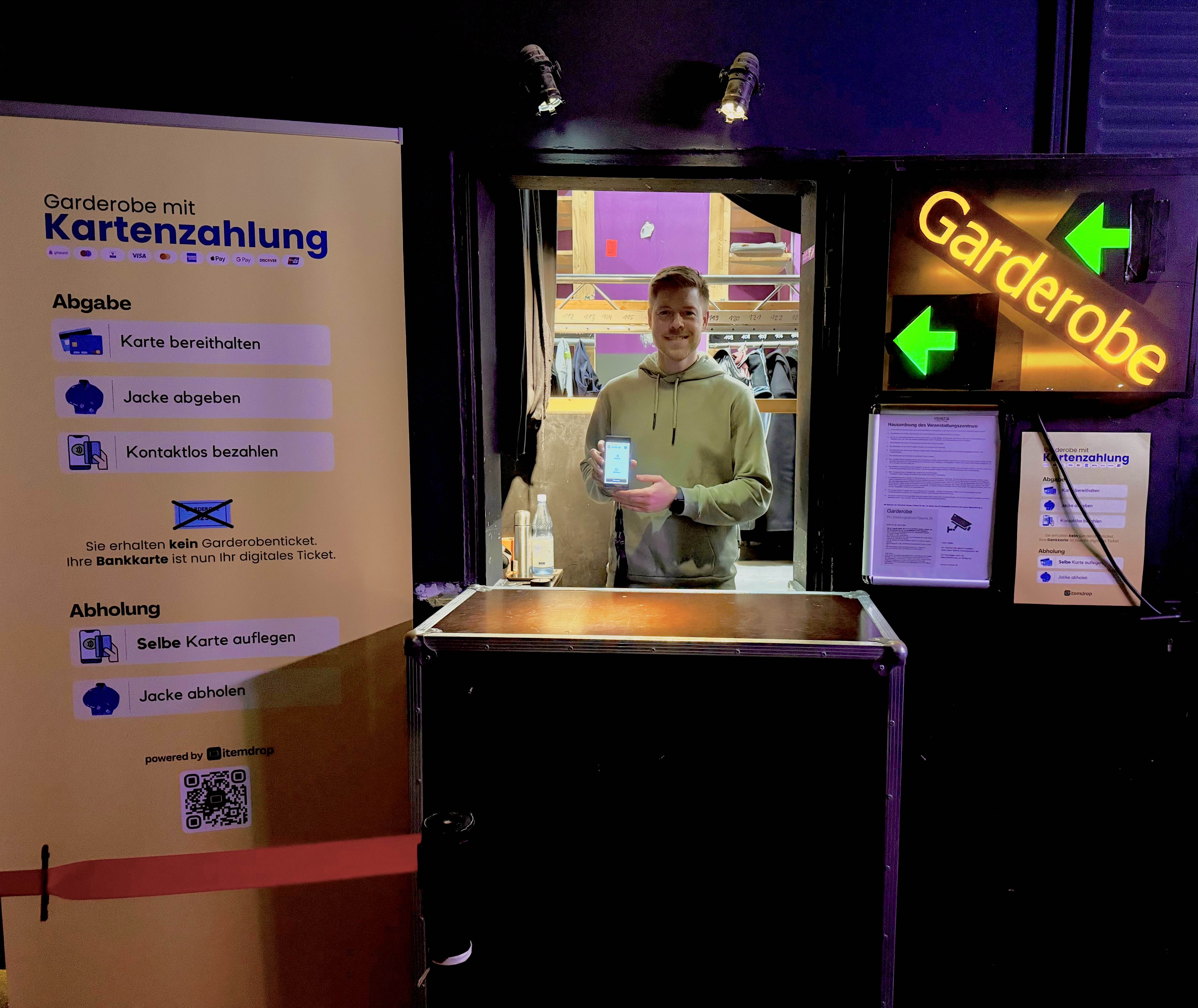
We announced it once on our social media channels: The cloakroom now operates cashless, only card payment.
And then we implemented it immediately. We deliberately did not work with two systems simultaneously because we wanted to test the new system properly and under full load.
Of course, there were a few guests who were surprised that they could no longer pay in cash, but overall, it worked very well.
Collaboration with itemdrop During the Introduction: Support, Training, Implementation
Question:
How did you experience the collaboration with itemdrop during the implementation? Did you feel well-supported? Was there sufficient support, e.g., for questions, adjustments, or technical issues?
Answer (GF36):
The support was truly very good. Our questions were always answered quickly, and not just during the day. Even at midnight, we still received feedback.
What I particularly noticed positively: The training for the night shift leaders was very well prepared. They had many questions and a few specific adjustment requests. These were implemented directly after the first applications. This direct feedback from practice was taken seriously and noticeably simplified operations.
The Greatest Advantages for the Business: Efficiency, Control, Transparency
Question:
If you had to name the most important advantages of the new system for you, what stands out the most? Which functions or features of itemdrop did you find most helpful?
Answer (GF36):
A major advantage is that guests no longer receive a physical cloakroom token. That alone eliminates many of the old problems: no lost tokens, no disputes, no misuse.
Additionally, there’s the time-saving aspect. The processes at the cloakroom run significantly faster. And the fact that no cash is circulating at the cloakroom is a security and organizational advantage, even though cash still plays a role on the Reeperbahn.
Another point: We now have a very clear overview of our cloakroom revenues at any time: when, how much, in which location. Since we have four different cloakrooms in use, it is extremely helpful to see which is currently how busy. This way, we can specifically direct guests and identify where additional staff may need to be deployed.
The "WOW" Moment After the Introduction
Question:
Was there a moment when it really hit you: Okay wow, the new system was worth it?
Answer (GF36):
Yes, the Monday after the first weekend. There were simply significantly fewer emails regarding lost items coming in. Really significantly less. I would say the effort was reduced by up to 90%.
Of course, there are still guests who lose something somewhere in the club. That will never be completely preventable. But as far as the cloakroom is concerned, the problem has almost disappeared. In the past, we would have at least one incident after every weekend. Now maybe once every six weeks. This not only makes operations more relaxed, it also saves real money. Because if a Wellenstein jacket or another expensive item needs to be replaced, that also represents a cost factor.
Noticeable Changes Since the Introduction: Work Practices, Behavior, Stress Levels
Question:
What has changed concretely in your operations since the introduction of the digital system? How do these changes affect your staff?
Answer (GF36):
Our staff functions very well with the system. After the training, there was a lot of positive feedback. It is significantly more pleasant for them to operate than the old system. For staff, it is more enjoyable because the guests are more relaxed. When processes run smoother, the atmosphere improves.
Another advantage is that we can now assess much more precisely how heavily individual cloakrooms are used. This helps us, for example, with long-term staff planning. We can now better decide: When does it make sense to keep certain cloakrooms open, such as in months like May or June? Such decisions can now be made based on data.
Impact on the Guest Experience
Question:
How do you think the experience for your guests has changed? And how does the new system affect overall operations at night?
Answer (GF36):
For the guests, the situation is clearly better today. The cloakroom process is much faster. Both at concerts and at parties.
In the past, if there was a problem at the cloakroom, it often disrupted the entire operational flow. This is now significantly less frequent. Overall, the operation at night is more peaceful and relaxed, not just for the cloakroom staff but also for our night shift leaders.
Interestingly, the guest often doesn’t immediately notice that something has changed. They have no comparison to the previous state. But the difference is there, and it is noticeable, especially for us in operations.
More Responsibility and Better Traceability Through Digital Processes
Question:
Have there been changes in the way your staff work due to itemdrop? Has the system contributed to making processes more transparent or understandable?
Answer (GF36):
Definitely. With the system, every staff member can now independently handle checkouts and hanging items, which was not possible before. Previously, you had to wait for a colleague to operate the printer or finish with the cash register. Now, each person is responsible for their own process. This makes the staff more flexible, independent, and I believe it also makes it more enjoyable for them. Everyone has their area of responsibility. This makes the processes clear and understandable.
Unified System Across Multiple Locations: Synergies in Operations
Question:
You operate several clubs on the Reeperbahn. What advantages do you see in using a unified cloakroom system across all locations?
Answer (GF36):
For us, this is a clear advantage. We have four venues on the Reeperbahn, and because the same system operates everywhere, direct synergies arise.
On one hand for the guests: Many of them visit several of our locations or move from one to another. Once they understand the system, they instantly know how it works. This saves explanation time and ensures a seamless process.
On the other hand for our staff: Our employees work across locations. Previously, moving to another venue often required relearning. That is no longer necessary. New staff only need to be trained once because the system works uniformly everywhere.
This was also a reason for us to integrate the system in all locations because it simply makes economic sense.
Recommendation to Other Companies
Question:
What would you advise other clubs or event organizers who are considering digitizing their cloakroom system? For whom do you think itemdrop is particularly suitable?
Answer (GF36):
I would clearly recommend the system. Especially to businesses currently still working with a system where guests receive something to hold. Such solutions are, in my view, always slower than itemdrop.
Another point: The effort for follow-up is significantly reduced with itemdrop. And that is a very relevant advantage for any company.
In general, the system is suitable for any business that has a cloakroom. Especially for those with a high number of guests or much turnover in the audience. It is fast, straightforward, and largely self-explanatory. This can be useful in practically any industry where guests check in clothing.
Jan 29, 2026
Interview with the management of Grosse Freiheit 36: This is how the digital wardrobe works at Grosse Freiheit 36
Learn more

Sep 1, 2025
The perfect wardrobe process – Why a wardrobe without brands is more efficient
Learn more

Aug 29, 2025
Luggage tags in the cloakroom – Why they are a real problem
Learn more