English (United States)

Jan 29, 2026

Interview with the management of Grosse Freiheit 36: This is how the digital wardrobe works at Grosse Freiheit 36

Interview with the management of Grosse Freiheit 36: This is how the digital wardrobe works at Grosse Freiheit 36

A man and his eagle look stoically ahead.

The challenges before the introduction of the new cloakroom system

Question:

Before you decided to implement our digital cloakroom system – what was your daily routine like with the old, analog system? What were the biggest challenges or stress factors in the day-to-day operation of the cloakroom?

Answer (GF36):

The biggest problem with the old system was clearly the handling of lost cloakroom tokens. This is simply because guests received something physical in their hands – and that could be easily lost.

At concerts, this was less dramatic; it happened occasionally. But at our parties, where guests had often drunk a lot, this happened regularly. The problem with this: If someone finds a lost token on the floor, they can simply go to the cloakroom and have the garment handed over.

And we cannot verify that. With 1,500 guests – or sometimes 2,000 to 3,000 in circulation – it is simply not possible to check if someone is really the owner. When a token is handed in, we have to automatically assume that the person in question also handed over the coat.

As a result, loss reports occurred almost every weekend. And that had consequences – for us in the office, that meant effort every time. Someone would contact us: "I lost my jacket." We operate four stores – and it’s often not even clear which one they were in. Then we have to find out: What was lost? Is it still in the cloakroom?

This had to be checked. We looked: Is there anything hanging there? Is there anything lying there? This meant effort every time in the follow-up, especially on Mondays and Tuesdays after the weekend. There were indeed a lot of emails coming in.

Question:

Were there other factors that made working with the previous system more difficult for you?

Answer (GF36):

Yes, a second major problem was the process itself – also architecturally conditioned. In our cloakroom, it was previously like this: An employee would check in the guest, collect the fee, hand out the token, and then pass on the information to the colleague on which hook the coat should go.

This, of course, slowed down the entire system, especially at concerts. We have one hour to get 1,500 people through the cloakroom. If that doesn’t work, guests miss the support or even the main act – that cannot happen. But with the old system, that was a real challenge.

Cash, cash management, and handling money in the old system

Question:

How was the cash situation for you before the introduction of the new system? Were there any difficulties or increased effort in handling money, during the checkout process, or in the accounting?

Answer (GF36):

Previously, everything was handled exclusively in cash. That means: You had to have change ready, count the money collected at the end – and the cloakroom staff were responsible for all of that.

Of course, mistakes can happen. There were times when money was given out incorrectly; that happened. These are the classic problems associated with cash. It’s additional effort, and there’s always the risk that something is wrong.

Impact of the old system on operations, staff, and guests

Question:

How did the previous manual system affect your operations – specifically on your staff and the guest experience?

Answer (GF36):

Guests were, of course, not thrilled when it took a long time at the cloakroom – which was often the case. Some arrive five minutes before the concert starts and expect to get to the front row. That’s illusory, but that’s the kind of guests you have.

Still, it’s frustrating when after the concert, you have to wait another three-quarters of an hour at the cloakroom. That certainly dampens the experience.

As for the fee – back then we charged two euros – it wasn’t really a big issue. Most thought that was acceptable. But there were always guests who said: "I don’t have cash on me – and if I can’t pay by card, I don’t want to use the cloakroom." And that was a problem.

Acceptance and experiences of staff with the old system

Question:

Was there dissatisfaction among your employees with the process? Or was the system just accepted as it was?

Answer (GF36):

The staff largely accepted the system. There was even an earlier version – that was even more complicated. A while ago, I think before COVID.

That was a system with printers and input fields. You had to print a label and attach it to the coat. It was laborious, but it was the same across all stores – so it was just used. But it was clear that it wasn’t optimal.

First contact with itemdrop: Expectations and decision process

Question:

What was your first impression when you first heard about itemdrop or tried the system? What was decisive for you?

Answer (GF36):

I was consciously looking for a cloakroom system that works "worry-free" – one that requires little follow-up. What bothered me most was that my staff had to spend so much time with lost items on Mondays and Tuesdays. That’s working time that I would have preferred to allocate more meaningfully.

Then I came across you – I don’t exactly remember where. I think it was an article on LinkedIn. I had looked at many other systems before, including ones with QR codes – but I still found that too cumbersome for today’s standards.

When we install something new, it should really be efficient – it should save time and resources. And itemdrop was the first system that, from my point of view, really met that requirement.

The transition to the new system – implementation and first practical use

Question:

How did you organize the transition to itemdrop? How difficult or easy was the transition from the old to the new system?

Answer (GF36):

We made a clear cut – no parallel operation, no test phase with both systems. We called multiple times beforehand, had everything explained in detail, and then decided: We will test it directly in real operation, in one of our stores, during the concert season. So that we can also test the system under real stress.

That worked very well that evening. We conducted training with our cloakroom staff – I thought it went quickly. In an hour, we had made most of them ready.

We also trained the night shift managers, especially in dealing with potential problem situations and troubleshooting. They quickly understood the system as well. I would say: The system is structured in a way that it can be implemented without any problems in an evening.

Communication with guests and transition to card payment

Question:

How did you inform your guests about the transition – especially regarding card payment?

Answer (GF36):

We announced it once on our social media channels: The cloakroom will now operate cashless, only card payment.

And then we implemented it immediately. We consciously did not work with two systems at the same time because we wanted to test the new system properly and under full load.

Of course, there were some guests who were surprised that they could no longer pay in cash – but overall it worked very well.

It naturally depends on the guest structure. The older the audience, the less common card payments are. We have all age groups at concerts – sometimes more explanation is needed, sometimes less. But with 1,500 guests, maybe ten people will say: "Then I won’t hand in my jacket." That’s manageable.

Cooperation with itemdrop during the introduction – support, training, implementation

Question:

How did you experience the collaboration with itemdrop during the implementation? Did you feel well supported? Was there sufficient support, e.g., for inquiries, adjustments, or technical issues?

Answer (GF36):

The support was really very good. Our questions were always answered quickly – and not just during the day. Even in the evening at 11 or 12 o'clock, there was still feedback.

What particularly stood out to me was that the training for the night shift leaders was very well prepared. They naturally had many questions and also a few specific requests for adjustments – these were implemented immediately after the first shifts. This direct feedback from practice was taken seriously and has noticeably simplified operations.

One example: For us, the "day" does not end at midnight, as is typically the case in daily business, but when the store actually closes – which may even be as late as seven in the morning. For accounting, the filters had to be adjusted accordingly.

This was implemented very quickly by itemdrop. Now we can display our revenues exactly for our internal time periods.

Another topic: Our employees work at a high pace, sometimes very quickly. In the beginning, it happened more often that they overlooked a step while checking out. This was also addressed – itemdrop adjusted the navigation so that this step is now better kept in view. That worked well. I was very satisfied with that.

The biggest advantages for operations – efficiency, control, transparency

Question:

If you had to name the most important advantages of the new system for you – what stands out the most? Which features or characteristics of itemdrop were the most helpful from your perspective?

Answer (GF36):

A huge advantage is that guests no longer receive a physical cloakroom token. That alone eliminates many of the old problems – no lost tokens, no discussions, no abuse.

Additionally, there is the time savings. The processes at the cloakroom run significantly faster. And having no cash circulating at the cloakroom is a security and organizational advantage – even though cash still plays a role on the street.

Another point: We now have a very clear overview of our cloakroom revenues at any time – when, how much, in which location. And: Since we have three different cloakrooms in use, it is enormously helpful to see which one is currently how busy. This way, we can strategically direct guests to where staff may need to be increased.

The "WOW" moment after the introduction

Question:

Was there a moment when you really realized: Okay wow, the new system was worth it?

Answer (GF36):

Yes – the Monday after the first weekend. There were simply significantly fewer emails coming in about lost items. Really significantly fewer. I would say: the effort was reduced by up to 90%.

Of course, there are still guests who lose something somewhere in the club – that can never be completely prevented. But as far as the cloakroom is concerned, the problem is virtually gone. Previously, after every weekend, we had guaranteed at least one incident. Now maybe once every six weeks. It not only makes operations more relaxed – it also saves real money. Because if a Wellenstein jacket or another expensive item needs to be replaced, that is, of course, a cost factor.

Tangible changes since the introduction – working methods, behavior, stress levels

Question:

What has changed concretely in your operation since the introduction of the digital system? How do the changes affect your staff and the guests?

Answer (GF36):

Our employees are coping very well with the system. After the training, there was a lot of positive feedback – it is much more pleasant for them to use than the old system.

Previously, it was like this: one would collect, and one would hang up. Now every employee can independently handle the entire process. That is a huge advantage given our architectural situation because we can act more flexibly and quickly.

It’s also more fun for the employees – simply because the guests are more relaxed. When processes run more smoothly, the atmosphere is better.

Another benefit is that we can now more accurately gauge how heavily individual cloakrooms are used. This helps us, for example, with long-term staff planning. We can now better decide: When does it make sense to keep certain cloakrooms open – for example, in months like May or June? Such decisions can now be made based on data.

Impact on the guest experience and the nightclub process

Question:

In your opinion, how has the experience for your guests changed? And how does the new system affect overall operations at night?

Answer (GF36):

The situation is clearly better for guests today. The cloakroom process runs faster – both at concerts and at parties.

Previously, if a problem occurred at the cloakroom, it often disrupted the entire flow of operations. That is now significantly less likely. Overall, the nighttime operation is calmer and more relaxed – not only for the cloakroom staff but also for our night shift leaders.

What is interesting is that the guest often doesn’t directly notice that something has changed – they don’t have a comparison to the previous state. But the difference is there, and it is tangible – especially for us in operations.

More responsibility and better traceability through digital processes

Question:

Has itemdrop changed the way your employees work? Has the system contributed to making processes more transparent or traceable?

Answer (GF36):

Definitely. With the system, now every employee can independently check out and hang up – that was not possible before. Previously, one had to wait for a colleague to operate the printer or finish with the cash register. Now everyone is responsible for their own process.

This makes employees more flexible and independent – and I believe it also makes it more enjoyable for them. Everyone has their area they are responsible for.

Another point is control. Since all devices operate user-specific – with a clear device number – we can trace afterwards who did what. This doesn’t mean we control every step. But if mistakes happen – and they do occasionally – we can now analyze that.

For example, if it is always the same employee who doesn’t run things smoothly, we can recognize that and consider: Is this person suited for that position? Or would they be better placed in another role?

This gives us the opportunity to take a closer look and to take structured countermeasures – which was not possible before.

Unified system across multiple locations – synergies in operations

Question:

You operate several clubs on the Reeperbahn. What advantages do you see through the implementation of a unified cloakroom system across all locations?

Answer (GF36):

For us, this is a clear advantage. We have four stores on the Reeperbahn – and because the same system operates everywhere, direct synergies arise.

On the one hand for the guests: Many of them visit several of our locations or move from one to the other. Once they understand the system, they immediately know how it works – that saves explanation effort and ensures a smooth process.

On the other hand for our staff: Our employees work across locations. Previously, one often had to retrain when changing to another store – now that is no longer necessary. New employees only need to be trained once because the system works the same everywhere.

That was also a reason for us to integrate the system in all locations – because it simply makes economic sense.

Reactions of guests to the new system

Question:

How did your guests react to the new system? Were there initial uncertainties, or did it settle down quickly?

Answer (GF36):

Our regular audience adapted very quickly. At the XXL party, for example, everyone knows how it works now – there are no more questions in the evening.

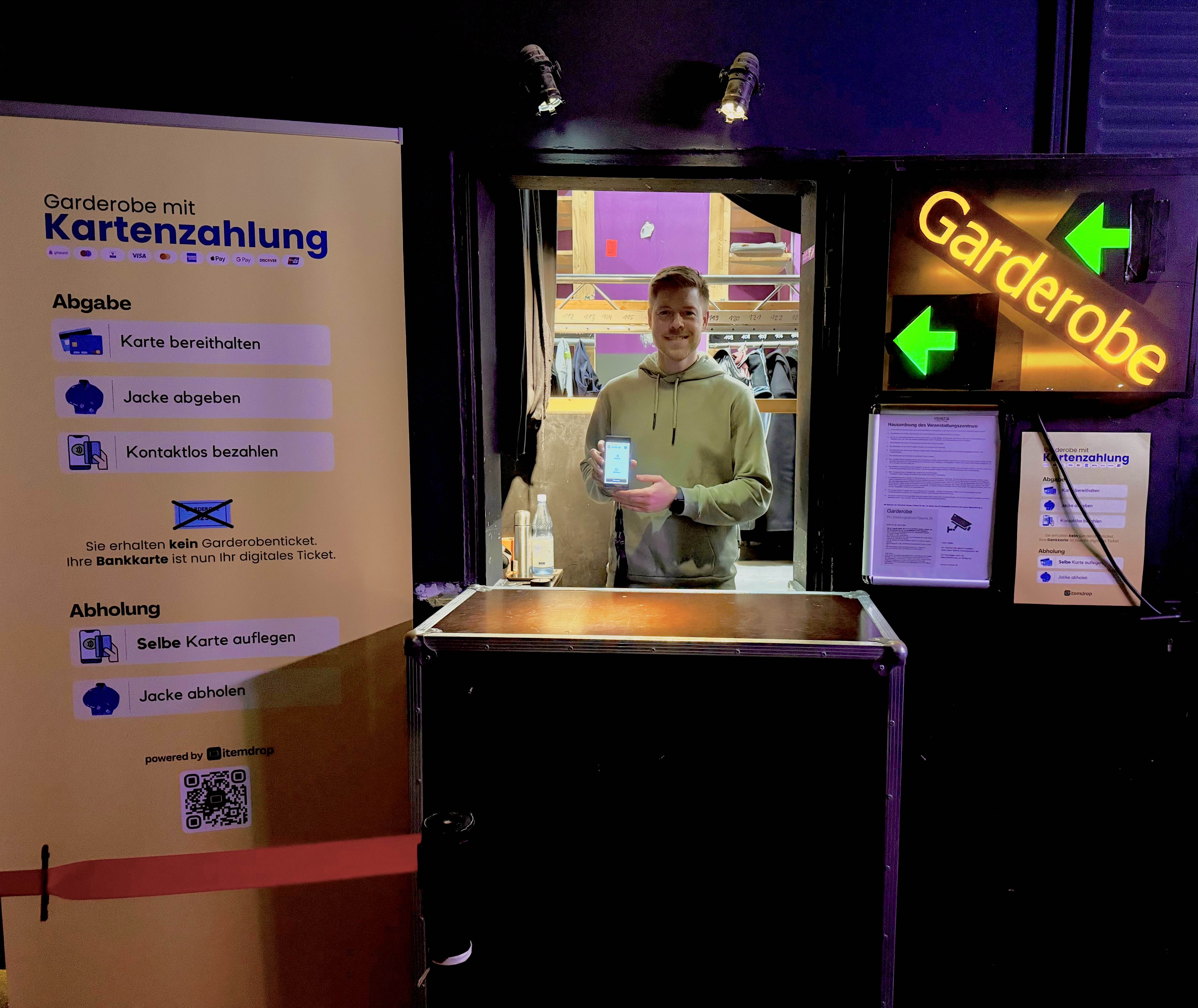
At concerts, it’s a bit different – many guests come to our locations for the first time. Occasionally, you still have to explain something there, but that works well. We have put up signs at the cloakrooms everywhere, and many simply look to see what people before them are doing.

Overall, it can be said: The system was very well received. And it works smoothly in everyday operations.

Recommendation to other companies

Question:

What would you advise other clubs or organizers considering digitizing their cloakroom system? For whom do you think itemdrop is particularly suitable?

Answer (GF36):

I would clearly recommend the system – especially to businesses that are currently still using a system where guests receive something in hand. Such solutions are always slower than itemdrop in my view.

Another point: The effort in the follow-up is significantly reduced with itemdrop. And that is a very relevant advantage for any business.

In general, the system is suitable for any operation that has a cloakroom – especially for those with a large number of guests or a lot of turnover in the audience. It is fast, uncomplicated, and largely self-explanatory. This can be useful in principle in all industries where guests hand over clothing.

Collaboration with the itemdrop team

Question:

How would you describe the collaboration with itemdrop overall – both during the implementation and in ongoing operations?

Answer (GF36):

The collaboration was and is very good. There was always a quick response – even in the evening, even on weekends. I remember a case when something didn’t go as planned on a Friday evening – and on Saturday, someone from your team drove from Düsseldorf to Hamburg. Such support is rare.

And I’m not saying this out of politeness – that was truly professional. Our questions were always answered promptly, problems were resolved, feedback was taken into account and implemented.

To be honest: We would wish for such collaboration from other partners as well. We feel very well supported.

Wishes for the future

Question:

Are there any functions or ideas you would like for the product?

Answer (GF36):

One wish would be that operators can prepare better for potential problems during payment processing – e.g., when banks or card payment systems are disrupted one evening.

If there were an early warning or a fallback solution, that would be helpful – simply to keep the operations running.

The challenges before the introduction of the new cloakroom system

Question:

Before you decided to implement our digital cloakroom system – what was your daily routine like with the old, analog system? What were the biggest challenges or stress factors in the day-to-day operation of the cloakroom?

Answer (GF36):

The biggest problem with the old system was clearly the handling of lost cloakroom tokens. This is simply because guests received something physical in their hands – and that could be easily lost.

At concerts, this was less dramatic; it happened occasionally. But at our parties, where guests had often drunk a lot, this happened regularly. The problem with this: If someone finds a lost token on the floor, they can simply go to the cloakroom and have the garment handed over.

And we cannot verify that. With 1,500 guests – or sometimes 2,000 to 3,000 in circulation – it is simply not possible to check if someone is really the owner. When a token is handed in, we have to automatically assume that the person in question also handed over the coat.

As a result, loss reports occurred almost every weekend. And that had consequences – for us in the office, that meant effort every time. Someone would contact us: "I lost my jacket." We operate four stores – and it’s often not even clear which one they were in. Then we have to find out: What was lost? Is it still in the cloakroom?

This had to be checked. We looked: Is there anything hanging there? Is there anything lying there? This meant effort every time in the follow-up, especially on Mondays and Tuesdays after the weekend. There were indeed a lot of emails coming in.

Question:

Were there other factors that made working with the previous system more difficult for you?

Answer (GF36):

Yes, a second major problem was the process itself – also architecturally conditioned. In our cloakroom, it was previously like this: An employee would check in the guest, collect the fee, hand out the token, and then pass on the information to the colleague on which hook the coat should go.

This, of course, slowed down the entire system, especially at concerts. We have one hour to get 1,500 people through the cloakroom. If that doesn’t work, guests miss the support or even the main act – that cannot happen. But with the old system, that was a real challenge.

Cash, cash management, and handling money in the old system

Question:

How was the cash situation for you before the introduction of the new system? Were there any difficulties or increased effort in handling money, during the checkout process, or in the accounting?

Answer (GF36):

Previously, everything was handled exclusively in cash. That means: You had to have change ready, count the money collected at the end – and the cloakroom staff were responsible for all of that.

Of course, mistakes can happen. There were times when money was given out incorrectly; that happened. These are the classic problems associated with cash. It’s additional effort, and there’s always the risk that something is wrong.

Impact of the old system on operations, staff, and guests

Question:

How did the previous manual system affect your operations – specifically on your staff and the guest experience?

Answer (GF36):

Guests were, of course, not thrilled when it took a long time at the cloakroom – which was often the case. Some arrive five minutes before the concert starts and expect to get to the front row. That’s illusory, but that’s the kind of guests you have.

Still, it’s frustrating when after the concert, you have to wait another three-quarters of an hour at the cloakroom. That certainly dampens the experience.

As for the fee – back then we charged two euros – it wasn’t really a big issue. Most thought that was acceptable. But there were always guests who said: "I don’t have cash on me – and if I can’t pay by card, I don’t want to use the cloakroom." And that was a problem.

Acceptance and experiences of staff with the old system

Question:

Was there dissatisfaction among your employees with the process? Or was the system just accepted as it was?

Answer (GF36):

The staff largely accepted the system. There was even an earlier version – that was even more complicated. A while ago, I think before COVID.

That was a system with printers and input fields. You had to print a label and attach it to the coat. It was laborious, but it was the same across all stores – so it was just used. But it was clear that it wasn’t optimal.

First contact with itemdrop: Expectations and decision process

Question:

What was your first impression when you first heard about itemdrop or tried the system? What was decisive for you?

Answer (GF36):

I was consciously looking for a cloakroom system that works "worry-free" – one that requires little follow-up. What bothered me most was that my staff had to spend so much time with lost items on Mondays and Tuesdays. That’s working time that I would have preferred to allocate more meaningfully.

Then I came across you – I don’t exactly remember where. I think it was an article on LinkedIn. I had looked at many other systems before, including ones with QR codes – but I still found that too cumbersome for today’s standards.

When we install something new, it should really be efficient – it should save time and resources. And itemdrop was the first system that, from my point of view, really met that requirement.

The transition to the new system – implementation and first practical use

Question:

How did you organize the transition to itemdrop? How difficult or easy was the transition from the old to the new system?

Answer (GF36):

We made a clear cut – no parallel operation, no test phase with both systems. We called multiple times beforehand, had everything explained in detail, and then decided: We will test it directly in real operation, in one of our stores, during the concert season. So that we can also test the system under real stress.

That worked very well that evening. We conducted training with our cloakroom staff – I thought it went quickly. In an hour, we had made most of them ready.

We also trained the night shift managers, especially in dealing with potential problem situations and troubleshooting. They quickly understood the system as well. I would say: The system is structured in a way that it can be implemented without any problems in an evening.

Communication with guests and transition to card payment

Question:

How did you inform your guests about the transition – especially regarding card payment?

Answer (GF36):

We announced it once on our social media channels: The cloakroom will now operate cashless, only card payment.

And then we implemented it immediately. We consciously did not work with two systems at the same time because we wanted to test the new system properly and under full load.

Of course, there were some guests who were surprised that they could no longer pay in cash – but overall it worked very well.

It naturally depends on the guest structure. The older the audience, the less common card payments are. We have all age groups at concerts – sometimes more explanation is needed, sometimes less. But with 1,500 guests, maybe ten people will say: "Then I won’t hand in my jacket." That’s manageable.

Cooperation with itemdrop during the introduction – support, training, implementation

Question:

How did you experience the collaboration with itemdrop during the implementation? Did you feel well supported? Was there sufficient support, e.g., for inquiries, adjustments, or technical issues?

Answer (GF36):

The support was really very good. Our questions were always answered quickly – and not just during the day. Even in the evening at 11 or 12 o'clock, there was still feedback.

What particularly stood out to me was that the training for the night shift leaders was very well prepared. They naturally had many questions and also a few specific requests for adjustments – these were implemented immediately after the first shifts. This direct feedback from practice was taken seriously and has noticeably simplified operations.

One example: For us, the "day" does not end at midnight, as is typically the case in daily business, but when the store actually closes – which may even be as late as seven in the morning. For accounting, the filters had to be adjusted accordingly.

This was implemented very quickly by itemdrop. Now we can display our revenues exactly for our internal time periods.

Another topic: Our employees work at a high pace, sometimes very quickly. In the beginning, it happened more often that they overlooked a step while checking out. This was also addressed – itemdrop adjusted the navigation so that this step is now better kept in view. That worked well. I was very satisfied with that.

The biggest advantages for operations – efficiency, control, transparency

Question:

If you had to name the most important advantages of the new system for you – what stands out the most? Which features or characteristics of itemdrop were the most helpful from your perspective?

Answer (GF36):

A huge advantage is that guests no longer receive a physical cloakroom token. That alone eliminates many of the old problems – no lost tokens, no discussions, no abuse.

Additionally, there is the time savings. The processes at the cloakroom run significantly faster. And having no cash circulating at the cloakroom is a security and organizational advantage – even though cash still plays a role on the street.

Another point: We now have a very clear overview of our cloakroom revenues at any time – when, how much, in which location. And: Since we have three different cloakrooms in use, it is enormously helpful to see which one is currently how busy. This way, we can strategically direct guests to where staff may need to be increased.

The "WOW" moment after the introduction

Question:

Was there a moment when you really realized: Okay wow, the new system was worth it?

Answer (GF36):

Yes – the Monday after the first weekend. There were simply significantly fewer emails coming in about lost items. Really significantly fewer. I would say: the effort was reduced by up to 90%.

Of course, there are still guests who lose something somewhere in the club – that can never be completely prevented. But as far as the cloakroom is concerned, the problem is virtually gone. Previously, after every weekend, we had guaranteed at least one incident. Now maybe once every six weeks. It not only makes operations more relaxed – it also saves real money. Because if a Wellenstein jacket or another expensive item needs to be replaced, that is, of course, a cost factor.

Tangible changes since the introduction – working methods, behavior, stress levels

Question:

What has changed concretely in your operation since the introduction of the digital system? How do the changes affect your staff and the guests?

Answer (GF36):

Our employees are coping very well with the system. After the training, there was a lot of positive feedback – it is much more pleasant for them to use than the old system.

Previously, it was like this: one would collect, and one would hang up. Now every employee can independently handle the entire process. That is a huge advantage given our architectural situation because we can act more flexibly and quickly.

It’s also more fun for the employees – simply because the guests are more relaxed. When processes run more smoothly, the atmosphere is better.

Another benefit is that we can now more accurately gauge how heavily individual cloakrooms are used. This helps us, for example, with long-term staff planning. We can now better decide: When does it make sense to keep certain cloakrooms open – for example, in months like May or June? Such decisions can now be made based on data.

Impact on the guest experience and the nightclub process

Question:

In your opinion, how has the experience for your guests changed? And how does the new system affect overall operations at night?

Answer (GF36):

The situation is clearly better for guests today. The cloakroom process runs faster – both at concerts and at parties.

Previously, if a problem occurred at the cloakroom, it often disrupted the entire flow of operations. That is now significantly less likely. Overall, the nighttime operation is calmer and more relaxed – not only for the cloakroom staff but also for our night shift leaders.

What is interesting is that the guest often doesn’t directly notice that something has changed – they don’t have a comparison to the previous state. But the difference is there, and it is tangible – especially for us in operations.

More responsibility and better traceability through digital processes

Question:

Has itemdrop changed the way your employees work? Has the system contributed to making processes more transparent or traceable?

Answer (GF36):

Definitely. With the system, now every employee can independently check out and hang up – that was not possible before. Previously, one had to wait for a colleague to operate the printer or finish with the cash register. Now everyone is responsible for their own process.

This makes employees more flexible and independent – and I believe it also makes it more enjoyable for them. Everyone has their area they are responsible for.

Another point is control. Since all devices operate user-specific – with a clear device number – we can trace afterwards who did what. This doesn’t mean we control every step. But if mistakes happen – and they do occasionally – we can now analyze that.

For example, if it is always the same employee who doesn’t run things smoothly, we can recognize that and consider: Is this person suited for that position? Or would they be better placed in another role?

This gives us the opportunity to take a closer look and to take structured countermeasures – which was not possible before.

Unified system across multiple locations – synergies in operations

Question:

You operate several clubs on the Reeperbahn. What advantages do you see through the implementation of a unified cloakroom system across all locations?

Answer (GF36):

For us, this is a clear advantage. We have four stores on the Reeperbahn – and because the same system operates everywhere, direct synergies arise.

On the one hand for the guests: Many of them visit several of our locations or move from one to the other. Once they understand the system, they immediately know how it works – that saves explanation effort and ensures a smooth process.

On the other hand for our staff: Our employees work across locations. Previously, one often had to retrain when changing to another store – now that is no longer necessary. New employees only need to be trained once because the system works the same everywhere.

That was also a reason for us to integrate the system in all locations – because it simply makes economic sense.

Reactions of guests to the new system

Question:

How did your guests react to the new system? Were there initial uncertainties, or did it settle down quickly?

Answer (GF36):

Our regular audience adapted very quickly. At the XXL party, for example, everyone knows how it works now – there are no more questions in the evening.

At concerts, it’s a bit different – many guests come to our locations for the first time. Occasionally, you still have to explain something there, but that works well. We have put up signs at the cloakrooms everywhere, and many simply look to see what people before them are doing.

Overall, it can be said: The system was very well received. And it works smoothly in everyday operations.

Recommendation to other companies

Question:

What would you advise other clubs or organizers considering digitizing their cloakroom system? For whom do you think itemdrop is particularly suitable?

Answer (GF36):

I would clearly recommend the system – especially to businesses that are currently still using a system where guests receive something in hand. Such solutions are always slower than itemdrop in my view.

Another point: The effort in the follow-up is significantly reduced with itemdrop. And that is a very relevant advantage for any business.

In general, the system is suitable for any operation that has a cloakroom – especially for those with a large number of guests or a lot of turnover in the audience. It is fast, uncomplicated, and largely self-explanatory. This can be useful in principle in all industries where guests hand over clothing.

Collaboration with the itemdrop team

Question:

How would you describe the collaboration with itemdrop overall – both during the implementation and in ongoing operations?

Answer (GF36):

The collaboration was and is very good. There was always a quick response – even in the evening, even on weekends. I remember a case when something didn’t go as planned on a Friday evening – and on Saturday, someone from your team drove from Düsseldorf to Hamburg. Such support is rare.

And I’m not saying this out of politeness – that was truly professional. Our questions were always answered promptly, problems were resolved, feedback was taken into account and implemented.

To be honest: We would wish for such collaboration from other partners as well. We feel very well supported.

Wishes for the future

Question:

Are there any functions or ideas you would like for the product?

Answer (GF36):

One wish would be that operators can prepare better for potential problems during payment processing – e.g., when banks or card payment systems are disrupted one evening.

If there were an early warning or a fallback solution, that would be helpful – simply to keep the operations running.

Experience itemdrop live in action

Experience itemdrop live in action

Book a free demo and see how easy the digital wardrobe works.

Book a free demo and see how easy the digital wardrobe works.

Mockup_Itemdrop-Handheld